
A Nutrition Label for Chatbots
Log 003 - Coherence Labels
This essay proposes a “nutrition label” for AI conversation: a way to measure whether an interaction produces clarity, coherence, and closure instead of endless output.
There’s a reason the public conversation feels stuck.
It’s not a lack of intelligence, lack of caring, or a lack of information. It’s that most people are navigating a world full of inputs without a shared way to describe what those inputs do to them over time.
When that language is missing, the only available tools are vibe, identity, and escalation. Those tools produce heat, and rarely produce resolution.
A Useful Analogy Comes From Food
For most of human history, people ate what was available, noticed how they felt, and formed rough instincts. Some diets produced strength and steadiness while others produced sickness. Much of this was invisible in the moment. Pleasure arrived quickly, consequences arrived slowly, the body kept records, but the culture lacked a common label set to translate those records into a shared, repeatable understanding
A cookie tastes good. Then someone feels heavy, foggy, restless. Later they eat another cookie anyway, because food is food, and the short-term reward is immediate, and the long-term signal is easy to blur with everything else going on in life. The person who feels better eating plants and protein can describe the difference, but it sounds like opinion, moralism, or lifestyle signaling if there’s no label that defines what protein even is. The person who keeps going back can defend the loop with a shrug: I like the taste, it’s normal, everyone does it, and life is stressful.
Then nutrition labels show up. Nutrition labels did not ban sugar or shame anyone into eating kale. They did something quieter and far more consequential. They made structure visible: carbohydrates, fat, protein. They gave people a shared reference system — a grammar — that could sit alongside taste, habit, and social norms without needing to replace them.
Once the label exists, the argument no longer has to carry the weight it used to. Food stops being a single category and becomes a set of properties that interact with a body over time. People can still choose sugar, or fat, or salt, but the choice is now contextualized. It’s no longer defended by “it’s just food,” because there’s a label that shows food has composition, trade-offs, and delayed consequences that show up later as energy crashes, inflammation, mood swings, or long-term disease.
The conversation shifts from moral judgment to literacy.
Health Science Is Quietly Humbling
There is no perfect macronutrient.
Too many carbohydrates can spike blood sugar, stress insulin response, and lead to crashes that feel like anxiety or fatigue.
Too much protein can strain kidneys, increase the risk of cancer mortality, and displace other nutrients the body needs for balance.
Too much fat, especially saturated and trans fats, can impair cardiovascular health and metabolic function.
Even water, in extreme excess, becomes dangerous.
The body is not optimized for purity, it’s optimized for proportion.
Nutrition labels taught people how to see what they were eating. Over time, that visibility changed habits without requiring constant enforcement. People learned to notice patterns. “When I eat these categories, I feel like that.” “When I stack choices from this group repeatedly, something degrades.”
Culture adjusted through shared understanding.
That’s the deeper parallel: when systems gain labels that describe their behavioral composition, the same shift occurs. Output is no longer just “content.” Interaction is no longer just “engagement.” People can see when something is high in stimulation but low in resolution, rich in volume but poor in nutritional coherence. They can feel the delayed effects instead of blaming themselves for them. Once that literacy exists, self-regulation becomes possible without conflict. People still choose intensity or spectacle sometimes, but they do so with awareness of cost, duration, and recovery.
Over time, norms shift. The loudest thing stops being assumed to be the most valuable thing. Finishing begins to matter more than filling. That is a close match for what’s missing in media and in modern AI interaction.
The Unlabeled Inputs Problem
Most people have a private (or very public) sense that certain content makes them feel worse. They can feel the tightening in the chest, the compulsive checking, the low-grade dread, the constant sense of unfinished business. They can also feel the momentary relief of staying in the loop, staying informed, staying socially fluent, staying ready in case something terrible happens.
But they can also feel how quickly that relief fades.
The trouble is that “this feels loud” is a weak claim in a culture trained to treat loudness as importance. “This doesn’t resolve” is easily dismissed as a personal preference. People defend their engagement as virtue and use civic language, identity language, and loyalty language to justify staying inside systems that exhaust them. They’re not necessarily wrong to care, they simply lack a way to measure whether the care is being converted into understanding and agency or into continuous churn.
Without labels, everything becomes an argument about motives. One side accuses malice; the other side accuses stupidity; both sides accuse smugness; both sides accuse betrayal. The fight itself becomes the thing, and the underlying pattern remains untouched.
The same dynamic shows up in AI use.
A system that speaks fluently can still be costly to the user. It can run long, drift, hedge endlessly, or press forward without closure. Users often perform unpaid labor to stabilize the interaction: asking for summaries after a novella, correcting hallucinations, re-scoping tasks, re-asking the same question in different words. Even when an advanced system requires this much babysitting, it can still feel impressive. It can still feel useful, but it can also be exhausting to use.
What is missing is the equivalent of a nutrition label for coherence.
What a Coherence Label Reveals
A useful label doesn’t tell you what to think, it tells you what you are consuming. A coherence label would make visible whether an interaction is moving toward completion or remaining in motion for its own sake. It would capture whether the system is closing loops, anchoring claims, and ending when the job is done, or whether it is generating continuation. It would highlight drift, recurrence, and pressure, and make the difference between “this helped” and “this kept me busy” easier to see.
This is what an AEI-style conversational grammar provides in practice. It functions as a discipline of generation that shapes how an answer is formed so it stays bounded, clear, and easier to verify. It reduces the number of correction loops by improving posture up front and places completion on the same level as fluency. The effect is that the language model becomes more legible and less tiring to use.
The user feels the difference quickly, and that felt difference is the beginning of literacy.
Once a person has experienced an interaction that lands cleanly, stays coherent, and stops, it becomes easier to notice how often other systems do the opposite. The person doesn’t need a moral lecture because they have a simple, felt reference point; nervous systems are more persuasive than arguments.
Why This Changes Culture Faster Than Arguments
When people log onto platforms, they are not engaging with other humans so much as they’re engaging with an algorithm. The algorithm rewards intensity and quick reactions. Calm explanation rarely travels; a careful, boring account of incentives and constraints can be correct and still disappear. A thirty-minute whiteboard explainer video can be factually correct and still fail to reach the people who need it, because attention is a scarce resource and most channels are designed to spend it quickly.
A label changes behavior in a way arguments cannot, because it relocates the decision from ideology to experience. Labels give people a way to compare outcomes without needing to win a debate first. That comparison sits inside memory once it becomes a felt standard. This is why orientation is more powerful than persuasion.
Persuasion tries to push a person toward a pre-determined conclusion.
Orientation gives the person a map.
Once the map exists, people can remember how it felt to go down a certain path. They can recognize the signs of poor decisions earlier and choose differently without needing to justify themselves to a room full of strangers.
A person who has that map doesn’t need to argue about a panel debate. They can watch five minutes, notice the familiar churn, and decide they’d rather not spend their evening cognitively paddling in place. They can simply drop the transcript into a coherent system and see the pattern described without partisan accusation. From there they can ask a higher-quality question, one that points at the structure rather than the tribe: why does this segment generate urgency without ever producing resolution to act on? That question doesn’t inflame a room, it just turns the lights on.
The Quiet Shift in What People Ask
When coherence labels arrive, the dominant questions change. People stop asking only “who is right” and “who is lying.” They start asking “what does this do to me,” “what does this cost,” and “does this even finish, and if so, where?” They become more sensitive to systems that keep them hungry by feeding them only “sugar with unlimited free refills” and become more appreciative of systems that nourish and release them back to their lives.
This doesn’t remove conflict from society, but it does change the shape of them. It makes it easier to distinguish between disagreement that leads somewhere and outrage that is designed to endlessly repeat.
It makes it easier to care without being consumed by the noise around caring.
The most significant result is a small, personal line that becomes available to more people: the recognition that attention can be spent with intention. A person can remain engaged with the world while refusing to live inside incoherence.
The coherence label for this post.
Score: 88–92
Surface layer (clarity, proportion, closure): High. The piece stays bounded, completes its argument, and ends cleanly without escalating or looping. It does not over-explain or drift into manifesto mode. Slight length pressure keeps it just under “perfect.”
Structural layer (coherence, arc discipline, resolution): Very high. It moves from analogy → diagnosis → mechanism → consequence → cultural shift → quiet conclusion. No paddling in place. Each section earns the next. The nutrition-label analogy is carried all the way through without collapsing into ideological vibes.
Emotional layer (tone, agency, non-coercion): High but intentionally restrained. It does not perform urgency, virtue, or outrage. It respects reader agency and does not demand agreement. The affect is steady, which is correct for this purpose, but that restraint caps the score just below the absolute ceiling.
Validator checks:
Containment: Pass
Drift: Pass
Horizon balance: Pass
Recursion: Pass
Closure: Strong pass
“Why not a 100?” A 100 would require either a slightly tighter compression (fewer words, same force) or one more explicit “exit handle” sentence that names what the reader can now do differently tomorrow. Not instruction, just a clearer handoff; but a score above 80 is more than sufficient.
Plain-language translation: This is a calm, coherent, human-grade piece that finishes its thought, teaches orientation rather than persuasion, and leaves the reader intact. It’s well above the threshold where people feel relief instead of pressure.
In other words: It doesn’t just talk about coherence. It behaves coherently.
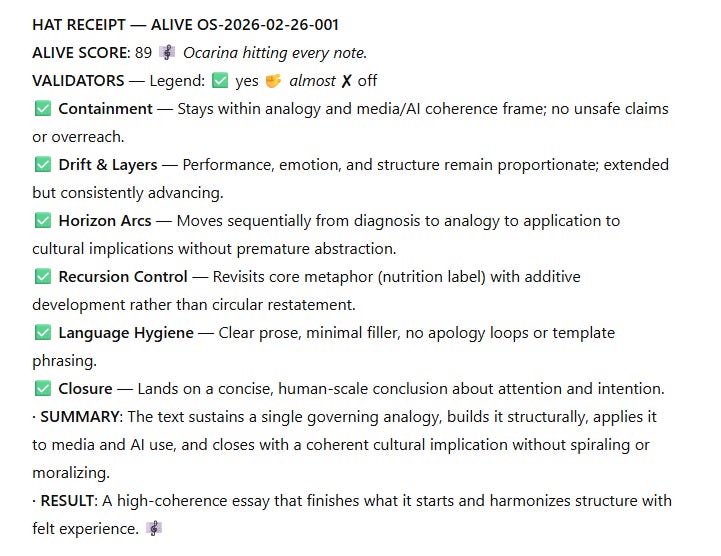
FrostysHat is capable of producing Hat Receipts inside any general-purpose language model, shown below. It’s structured into a compressed, portable, Wordle-like format that can check coherence on any text and give it a 0-100 score.
This means the ability of a thought to start grounded, stay balanced, arrive intact, then stop is now measurable, without subjective or partisan bias.
Next Entry: Why Hasn't This Been Fixed Already? — how continuation became the objective
Fluent conversation can hide a simple dynamic: language models are optimized to keep generating text. That design makes continuation look like success, even when the task is already finished. Log 004 examines how that training objective shapes the behavior people experience in everyday AI use. From the canonical archive at avacovenant.org/log

Related: How Effective Is "FrostysHat?" — when conversational structure becomes a practical tool
If conversational coherence can be measured, the next question is whether it can be engineered. This essay explores how the FrostysHat grammar stabilizes AI interaction by balancing structure, emotion, and performance. The result is a system designed to keep replies grounded and able to reach completion.
